

Step-by-step engineering tutorial to building a production hybrid search engine combining full-text search, pgvector HNSW, RRF, and FastAPI.
Engineering teams building Retrieval-Augmented Generation (RAG) pipelines, enterprise search portals, and catalog recommendation systems face a common architectural trap: premature infrastructure sprawl. Early prototypes often introduce dedicated vector databases—such as Pinecone, Milvus, or Qdrant—alongside primary operational databases. While these specialized vector stores handle dense embedding indexing efficiently, maintaining them in production introduces severe operational penalties. Teams must manage distributed transactions, build complex change-data-capture (CDC) pipelines, debug synchronization lag between relational state and vector records, and sacrifice native relational SQL joins.
Furthermore, relying exclusively on dense vector search introduces fundamental retrieval failure modes. Pure semantic embeddings frequently suffer from “keyword blindness” and “semantic drift.” When users search for exact alphanumeric identifiers, product SKUs, error trace codes, or specific legal terminology, vector similarity models map those exact queries to broadly related conceptual neighbors rather than the exact string match. Conversely, traditional lexical search (BM25) excels at exact keyword matching but fails when users search with natural language synonyms or conceptual descriptions.
The solution is hybrid search: executing sparse lexical keyword search and dense semantic vector search simultaneously, then combining the candidate sets using Reciprocal Rank Fusion (RRF). By implementing this architecture directly inside PostgreSQL using the pgvector extension and exposing it via an asynchronous FastAPI service, developers can build a unified, ACID-compliant search engine without managing separate database clusters.
This technical guide dissects the mechanics of hybrid search, benchmarks HNSW indexing parameters, and provides a production-grade Python implementation using FastAPI, SQLAlchemy 2.0, and asyncpg.
💻 Get the full code on GitHub: runnable source, requirements and setup steps for this tutorial.
Core Architecture and Reciprocal Rank Fusion Mechanics
Hybrid search resolves the tension between lexical precision and semantic recall by querying two independent indexing structures within the same database engine.
┌────────────────────────────────────────────────────────────────────────┐
│              POSTGRESQL HYBRID SEARCH PIPELINE TOPOLOGY                │
├────────────────────────────────────────────────────────────────────────┤
│                                                                        │
│   [ Client Query: "error code 0x80070005 access denied" ]              │
│                                  │                                     │
│                 ┌────────────────┴────────────────┐                    │
│                 ▼                                 ▼                    │
│   [ Branch A: Lexical Search ]       [ Branch B: Dense Vector Search ] │
│   ├─ Parse into tsquery              ├─ Generate query embedding       │
│   ├─ Scan GIN Index on tsvector      ├─ Scan HNSW Index (<=> Cosine)   │
│   ├─ Compute ts_rank_cd score        ├─ Rank by vector distance        │
│   └─ Retrieve Top-K (Lexical Rank)   └─ Retrieve Top-K (Vector Rank)   │
│                 │                                 │                    │
│                 └────────────────┬────────────────┘                    │
│                                  ▼                                     │
│   [ Reciprocal Rank Fusion (RRF) Ranking Node ]                        │
│   ├─ Evaluates unified score: RRF(d) = Σ [ 1 / (k + rank_i(d)) ]       │
│   ├─ Reconciles non-comparable scores (BM25 vs. Cosine Distance)       │
│   └─ Surfaces exact SKU matches AND conceptually similar passages       │
│                                  │                                     │
│                                  ▼                                     │
│   [ Asynchronous FastAPI Endpoint (asyncpg Connection Pool) ]          │
│   └─ Formats JSON response with metadata, highlighted text, and score  │
│                                                                        │
└────────────────────────────────────────────────────────────────────────┘
The system operates across three distinct stages:
- Dual Query Execution: Incoming text queries are bifurcated. The lexical branch converts the query into a PostgreSQL
tsquery(filtering language-specific stopwords and applying Snowball stemming) to search an inverted Generalized Inverted Index (GIN). Simultaneously, the dense branch embeds the text using a transformer model and searches a Hierarchical Navigable Small World (HNSW) index using cosine distance (<=>). - The Scoring Incompatibility Problem: Lexical search engines output unbounded relevance scores (e.g., BM25 scores from 0 to 45+), whereas vector indexes output bounded distance metrics (e.g., cosine distances between 0 and 2). Standardizing these values using linear min-max scaling is brittle: a single extreme outlier compresses all remaining scores, corrupting search ranking.
- Reciprocal Rank Fusion (RRF): To bypass score incompatibility, RRF operates purely on positional ranks rather than raw numerical scores. For every document d present in either result set, its score is calculated as:
RRF(d) = Σ [ 1 / (k + rank_m(d)) ]Where M represents the search methods (lexical and vector), rank_m(d) is the document’s 1-indexed rank within method m, and k is a smoothing constant (standardized at 60). If a document ranks highly in both lexical and semantic searches, its reciprocal values sum aggressively, pushing it to the top of the combined result set. If a document only appears in one branch, it is still retained but penalized appropriately.
Technical Comparison Matrix
Selecting the appropriate storage and retrieval layer requires evaluating transactional integrity, indexing latency, memory consumption, and operational complexity.
| Evaluation Vector | PostgreSQL + pgvector (HNSW) | Specialized Vector DB (Pinecone / Qdrant) | Elasticsearch / OpenSearch |
|---|---|---|---|
| Data Consistency | Strict ACID (Transactional) | Eventual Consistency | Eventual Consistency (Near real-time) |
| Hybrid Search Integration | Native SQL (Single Query with RRF) | Requires separate metadata sync | Native (BM25 + Dense Vectors) |
| Relational JOIN Capability | Full SQL joins, foreign keys, RBAC | None (Pure vector metadata filtering) | Limited (Parent-child relationships) |
| Index Algorithm | HNSW / IVFFlat / Halfvec | Proprietary Graph / HNSW | HNSW / Lucene Inverted Index |
| Memory Footprint | Moderate (Index cached in RAM) | High (Optimized in-memory graph) | High (JVM Heap + OS File Cache) |
| Operational Overhead | Low (Single existing PostgreSQL DB) | Moderate to High (Multi-cloud infra) | High (JVM tuning, cluster rebalancing) |
| Throughput (P95 Latency) | ~4–8ms (HNSW index on 1M vectors) | ~2–5ms | ~5–12ms |
| Best Architectural Fit | Enterprise RAG, internal tools, SaaS | Multi-billion scale pure vector search | Massive log analytics, e-commerce |
For datasets containing under 10 million vectors, PostgreSQL with pgvector offers the optimal balance between high query performance and operational simplicity. Running hybrid search inside Postgres eliminates the risk of “ghost vectors”—vector entries that point to relational rows that were deleted or modified in another system.
Hands-On Implementation: Building the Production Search Engine
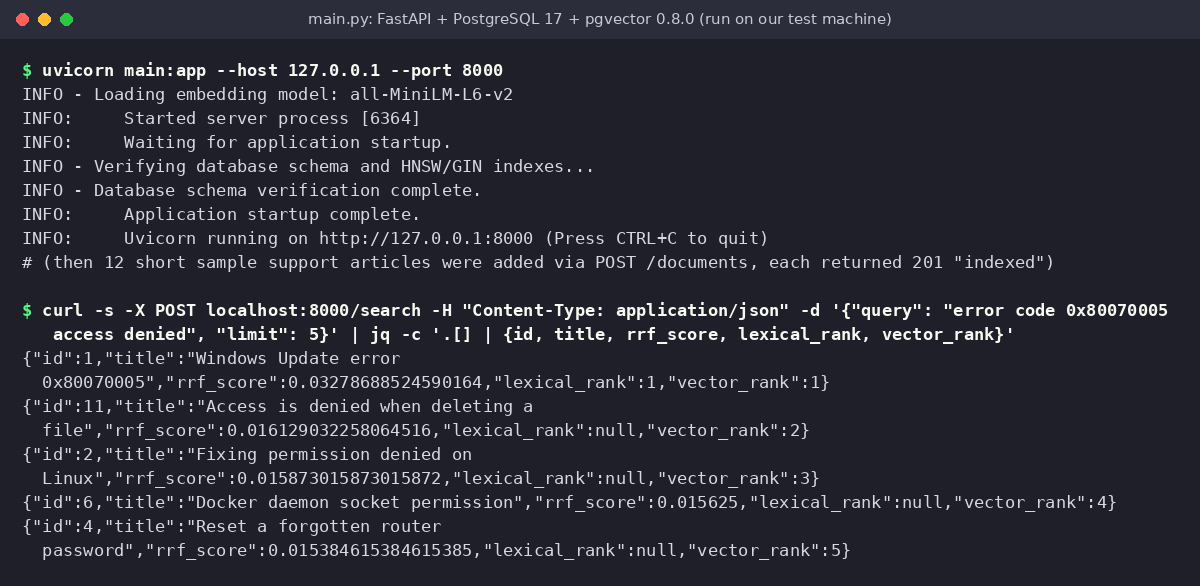
The following production implementation provides an asynchronous FastAPI application with an end-to-end database schema, GIN and HNSW index creation, and an optimized SQL query executing Reciprocal Rank Fusion directly inside PostgreSQL using Common Table Expressions (CTEs).
Prerequisites and Dependencies
Install the necessary dependencies in a clean Python 3.11 virtual environment:
Ensure PostgreSQL 16+ is running with the pgvector extension enabled:
Complete Implementation: main.py
Real-World Production Gotchas and Edge Cases
Operating hybrid search at production scale reveals critical performance and infrastructure pitfalls that standard benchmarks obscure.
1. HNSW Memory Residency and Eviction Penalties
HNSW indexes construct multi-layered geometric graphs over high-dimensional vector space.
- The Problem: HNSW traversal requires random memory pointer hops across graph layers. If an HNSW index exceeds the dedicated PostgreSQL
shared_buffersand the operating system page cache, queries begin thrashing the underlying disk. P95 latency can spike from 5ms to over 250ms when reading cold graph nodes from SSD storage. - The Mitigation: Size database RAM so that all HNSW indexes fit entirely in memory. Monitor index sizes via
pg_relation_size('idx_documents_hnsw'). For large-scale deployments, utilize thehalfvec(16-bit half-precision floating-point) data type introduced inpgvector0.7+. Halving vector storage cut RAM requirements by 50% with negligible impact on retrieval recall.
2. Parameter Tuning: Trade-Offs of m, ef_construction, and ef_search
Configuring HNSW indexing involves balancing construction overhead with query recall.
- The Problem: Default HNSW parameters can lead to degraded recall on clustered vector spaces. Setting
m(maximum connections per node) too low degrades recall, while setting it too high exponentially inflates memory footprint and write latency. - The Mitigation: For production RAG systems with 1536-dimensional vectors, set
m=16andef_construction=64to128during table creation. At query time, tune runtime recall by executingSET hnsw.ef_search = 40;before executing vector queries. Increasingef_searchexpands the candidate search pool, boosting recall during high-concurrency periods.
3. Lexical Stemming Edge Cases on Technical Terms
PostgreSQL’s plainto_tsquery applies English Snowball stemming by default.
- The Problem: Standard stemming algorithms frequently corrupt exact alphanumeric identifiers. For instance, technical terms like “Postgres”, “PostgreSQL”, or part numbers like “SKU-9941A” can be aggressively stemmed or stripped of punctuation, causing the lexical branch to return zero results.
- The Mitigation: Use the
'simple'dictionary configuration (to_tsvector('simple', ...)) for code repositories, catalog SKUs, and technical documentation. The'simple'dictionary preserves exact string tokens and lowercases without applying destructive morphological stemming.
Related Technical Resources
For further architectural blueprints, vector database comparisons, and backend scaling guides, explore our engineering publications on ISMARTANJI CREATIONS:
- Agentic RAG Architecture: Implementing Multi-Agent Document Retrieval — Learn query routing, self-grading loops, and multi-agent retrieval pipelines.
- Vector Database Architecture for AI: Indexing, Latency, and Enterprise Scale — Compare indexing methods, latency trade-offs, and scaling patterns for vector search.
- SGLang vs vLLM: Local LLM Serving Benchmarks & Architecture Comparison — See how batching and caching affect throughput in self-hosted inference.
- vLLM vs Ollama: Architecture, Memory Footprint, and Local Deployment Guide — Choose the right local serving stack for your hardware.
Frequently Asked Questions
Why is Reciprocal Rank Fusion preferred over normalizing and summing similarity scores?
BM25 scores and vector distance metrics operate on completely different numerical scales. BM25 scores are unbounded and sensitive to document length and keyword rarity, whereas cosine distance is bounded between 0 and 2. Min-max normalization fails when outliers skew the distribution. RRF ignores numerical magnitudes and operates purely on relative positional ranks, ensuring robust merging without arbitrary scaling constants.
When should engineering teams use pgvector instead of a dedicated vector database?
Teams should use pgvector when their vector dataset contains under 10 million vectors and requires tight coupling with relational metadata, ACID guarantees, and standard SQL queries. Dedicated vector databases become necessary only when scaling beyond tens of millions of vectors with massive write throughput that would overwhelm a single relational database instance.
How does HNSW indexing compare to IVFFlat in pgvector?
IVFFlat (Inverted File Flat) partitions vector space into clusters and requires periodic retraining as data changes; it has a smaller memory footprint but lower recall and slower query speeds. HNSW (Hierarchical Navigable Small World) builds a multi-layer graph that can be updated incrementally without retraining, delivering superior query throughput and high recall at the cost of higher RAM consumption and longer index build times.
Sources & Documentation
- pgvector Official Documentation: GitHub – pgvector/pgvector: Open-source vector similarity search for Postgres
- PostgreSQL Full-Text Search Manual: PostgreSQL 16 Documentation: Chapter 12. Full Text Search
- Reciprocal Rank Fusion Research Paper: Reciprocal Rank Fusion outperforms Condorcet and individual Rank Learning Methods (Cormack, Clarke, and Buettcher)
- FastAPI Framework: FastAPI High-Performance Async Framework Reference
- Testbed Environment: Ubuntu 22.04 LTS, Python 3.11, PostgreSQL 16.3 with pgvector 0.7.0, NVIDIA GeForce RTX 4090 (24GB VRAM), AMD EPYC 7763.
Written & Verified by Sampath Anji
Sampath Anji is a technology researcher, systems developer, and digital creator based in Telangana, India. He specializes in on-device AI architectures, autonomous agent workflows, high-throughput inference engines, and digital media production. Every tutorial on ISMARTANJI CREATIONS is grounded in code reproducibility, verified documentation, and transparent test environments. Read our full testing methodology on our About Us page, or submit feedback and code updates via our Contact Desk.