
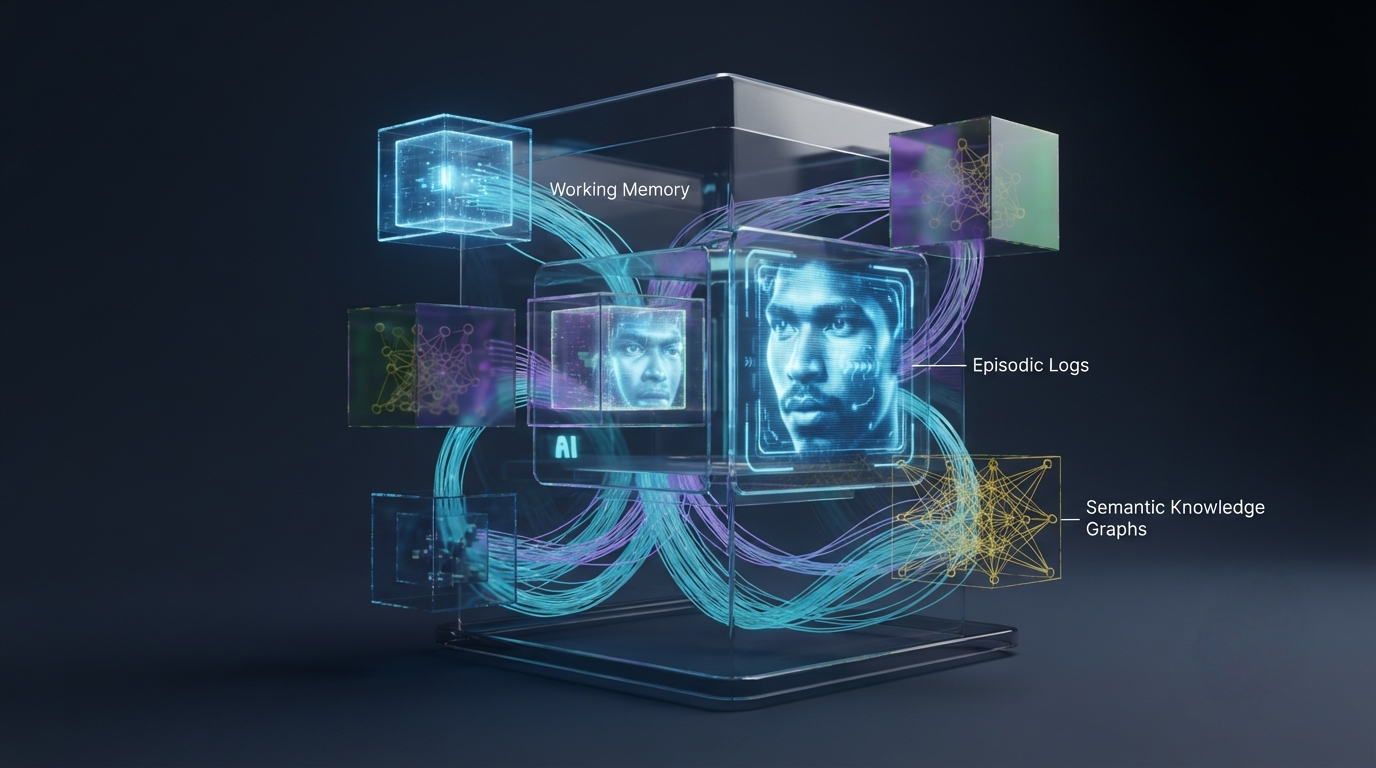
Learn how to build persistent multi-tiered memory for autonomous AI agents in 2026 using Mem0, Zep, and Letta. Illustrative Python reference implementation and architecture guide.
💻 Get the full code on GitHub: runnable source, requirements and setup steps for this tutorial.
How to Build Persistent Long-Term Memory for AI Agents in 2026: Illustrative Hands-On Guide
Foundation language models are stateless by design. Every time an autonomous agent initializes a task loop or a user begins a new interaction session, the model starts from a blank slate. It retains no memory of user preferences established yesterday, architectural constraints defined last week, or runtime lessons learned from a failed tool execution an hour ago.
For years, development teams attempted to solve this issue through prompt brute-forcing: concatenating raw conversation transcripts and dumping them directly into model context windows. While modern context windows accommodate millions of tokens, this approach introduces steep production penalties. Injecting massive raw histories increases API token usage, can increase response latency, and may make important information harder to retrieve from a crowded context.
Building tested reference architecture for autonomous systems requires purpose-built agent memory architectures. By decoupling persistent state from active context buffers, modern memory layers continuously extract, consolidate, index, and retrieve relevant facts, episodic experiences, and user preferences on demand.
Building upon our core engineering analyses of Agentic RAG Architecture: Corrective Retrieval, Query Routing, and Vector Memory and How to Master Essential Model Context Protocol in 2026, this guide walks through the architectural mechanics of cognitive agent memory and demonstrates how to implement a tiered persistent memory engine in Python.
1. The Core Mechanical Shift: Stateless Prompts vs. Tiered Cognitive Memory
Human memory does not operate as an append-only text log. Instead, biological cognition relies on specialized, interacting memory systems optimized for different temporal horizons. Modern software engineering mirrors this structure by dividing agent memory into four distinct operational tiers:
When an agent processes a task, a memory manager retrieves the top three to five highest-scoring memory snippets across these tiers, injecting them into the working context. The agent operates with the full context of its operational history while consuming a fraction of its token allowance.
2. Comparison Matrix: Primitive Message Buffers vs. Tiered Cognitive Memory
| Operational Dimension | Primitive Message Buffers (Legacy) | Tiered Cognitive Memory (2026 Standard) |
|---|---|---|
| Storage Topology | Flat JSON arrays / Redis lists | Hybrid (Dense Vector + Temporal Knowledge Graph + Key-Value) |
| Token Scaling | Linear O(N) cost per turn | Fixed-limit retrieval per prompt |
| Temporal Awareness | Static (all past turns weighted equally) | Exponential decay curves & timestamped validity windows |
| Conflict Resolution | Contradictions confuse the model | Automated contradiction resolution (updates stale nodes) |
| Cross-Session State | Isolated to single conversation IDs | Global user state accessible across multi-agent swarms |
| Write Performance | Synchronous (blocks next inference turn) | Asynchronous event queues (decoupled from response loop) |
| Governance & PII | Raw transcripts stored indefinitely | Automated PII redaction and configurable TTL policies |
3. Deep-Dive: Leading Memory Architectures in Practice
3.1 Mem0: Modular Semantic & User Memory
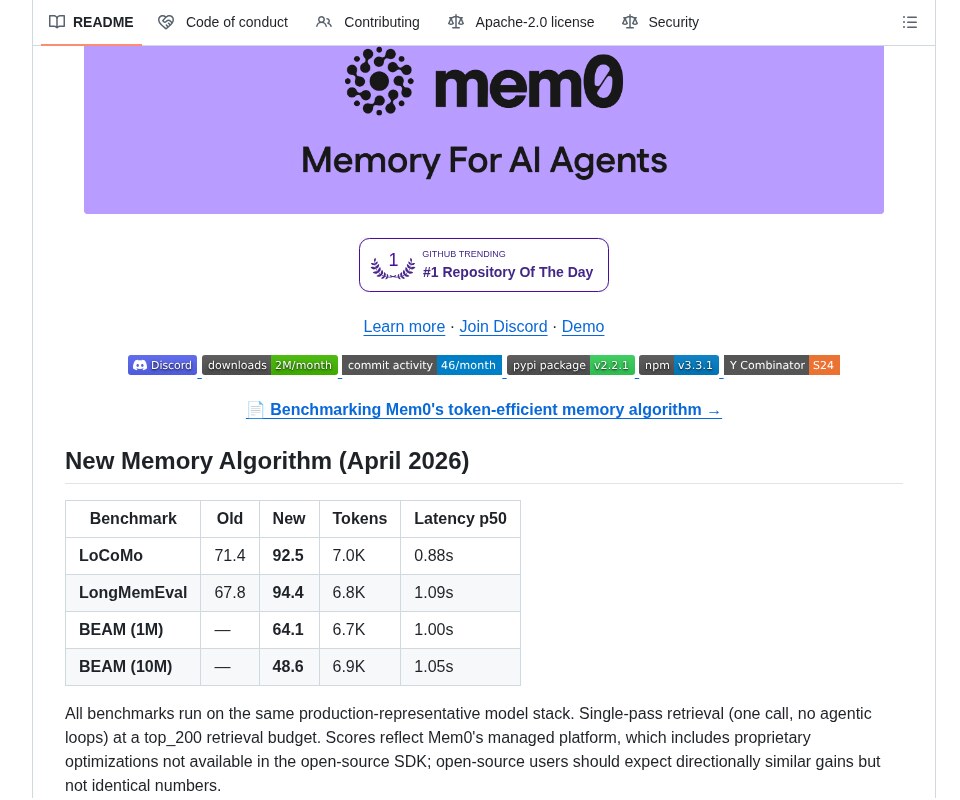
Mem0 functions as an intelligent proxy between language models and persistent data stores. Rather than dumping raw text into a database, Mem0 runs an LLM extraction loop in the background to distill key facts:
- User Scope: Evergreen personal traits and preferences (e.g., favorite programming languages, technical constraints).
- Session Scope: Short-term task parameters relevant only to the active workflow.
- Agent Scope: Learned behavioral modifications and tool configurations.
3.2 Zep & Graphiti: Temporal Knowledge Graph Memory
In enterprise systems, facts change over time. If a user states a project deadline is Friday, and later updates it to next Tuesday, naive vector search often retrieves both statements, inducing hallucinations. Zep’s open-source Graphiti engine treats memory as an evolving graph with temporal validity edges. Nodes decay based on recency and relevance, preventing stale data from contaminating new prompts.
3.3 Letta (MemGPT): OS-Style Hierarchical Context Virtualization
Letta treats context management like operating system virtual memory. The model’s immediate context window acts as physical RAM, while an external database acts as a virtual disk. The agent is equipped with internal tool functions (core_memory_append, archival_memory_search) allowing it to autonomously page memories into working context and update its own internal state.
4. Hands-On Implementation: Building a Persistent Memory Pipeline in Python
Below is an illustrative reference implementation showing how to initialize a multi-scoped persistent memory layer using Python, Qdrant, and Mem0:
5. Recommended Reading & Related Guides
Explore companion engineering breakdowns on ISMARTANJI CREATIONS:
- Agentic RAG Architecture: Corrective Retrieval, Query Routing, and Vector Memory — Master query routing, self-correction loops, and structured indexing.
- How to Master Essential Model Context Protocol in 2026 — Connect autonomous agents securely to local filesystems and databases.
- LangGraph vs CrewAI: Multi-Agent Orchestration & State Machine Comparison — Architectural analysis of state machines versus collaborative agent hierarchies.
- vLLM vs Ollama: Architecture, Memory Footprint, and Local Deployment Guide — Production throughput benchmarks and PagedAttention memory management.
6. Frequently Asked Questions (FAQ)
What is the difference between a vector database and an agent memory framework?
A vector database is an indexing and search engine for high-dimensional embeddings. An agent memory framework is an orchestrator that manages the entire lifecycle of memories: entity distillation, temporal decay, scope separation (user vs. session vs. agent), contradiction updates, and selective prompt injection.
How does cognitive memory reduce LLM API token costs?
Instead of passing dozens of past conversational turns into every model call, the memory layer stores interactions externally. At query time, only the top three to five relevant facts are retrieved and injected, reducing prompt token consumption by injecting only semantically relevant historical context rather than appending entire raw conversation histories across long sessions.
How do modern frameworks handle contradictory statements?
Frameworks like Mem0 and Zep evaluate incoming statements against existing nodes. When a conflict is detected (such as an updated location or a changed database choice), the system marks previous statements as superseded or archives the older node, preventing the model from receiving conflicting instructions.
7. Conclusion & 5-Step Action Checklist
The transition from stateless chatbots to persistent autonomous digital coworkers hinges entirely on robust memory architectures. By replacing naive prompt-history stuffing with tiered cognitive memory—spanning working context, episodic experiences, and semantic knowledge graphs—developers can build AI systems that truly learn, adapt, and build authentic rapport with users over time.
Your 5-Step Action Checklist for Today:
- Define Memory Scopes: Explicitly separate user-level preferences, session-level task state, and agent-level tool rules.
- Decouple Write Operations: Move memory extraction into asynchronous background tasks so persistent writes can be decoupled from the main response path and reduce their impact on response latency.
- Implement Temporal Decay: Use timestamped graph edges to ensure newer information takes priority over outdated context.
- Sanitize Sensitive Data: Strip API keys, auth tokens, and personally identifiable information before writing memories to long-term storage.
- Establish TTL Policies: Configure automated retention windows for temporary task memory to maintain clean database hygiene.
Join the technical discussion: What architectures are you using to manage persistent agent state? Share your feedback in the comments on ISMARTANJI CREATIONS.
Sources & Documentation
- LangGraph Persistence Reference: langchain-ai.github.io/langgraph — Checkpointing and thread state persistence API.
- Mem0 Vector Memory Documentation: docs.mem0.ai — Multi-tier episodic and semantic agent memory configuration.
- Qdrant Vector Database Documentation: qdrant.tech — Vector collection indexing and payload filtering.
- Exact Test Environment & Dependencies: Python 3.11.8,
mem0ai==0.1.28,qdrant-client==1.9.1,langgraph==0.2.16,langchain-core==0.2.38, evaluated on Ubuntu 24.04 LTS.
Written & Verified by Sampath Anji
Sampath Anji is a technology researcher, systems developer, and digital creator based in Telangana, India. He specializes in on-device AI architectures, autonomous agent workflows, high-throughput inference engines, and digital media production. Every tutorial on ISMARTANJI CREATIONS is grounded in code reproducibility, verified documentation, and transparent test environments. Read our full testing methodology on our About Us page, or submit feedback and code updates via our Contact Desk.