
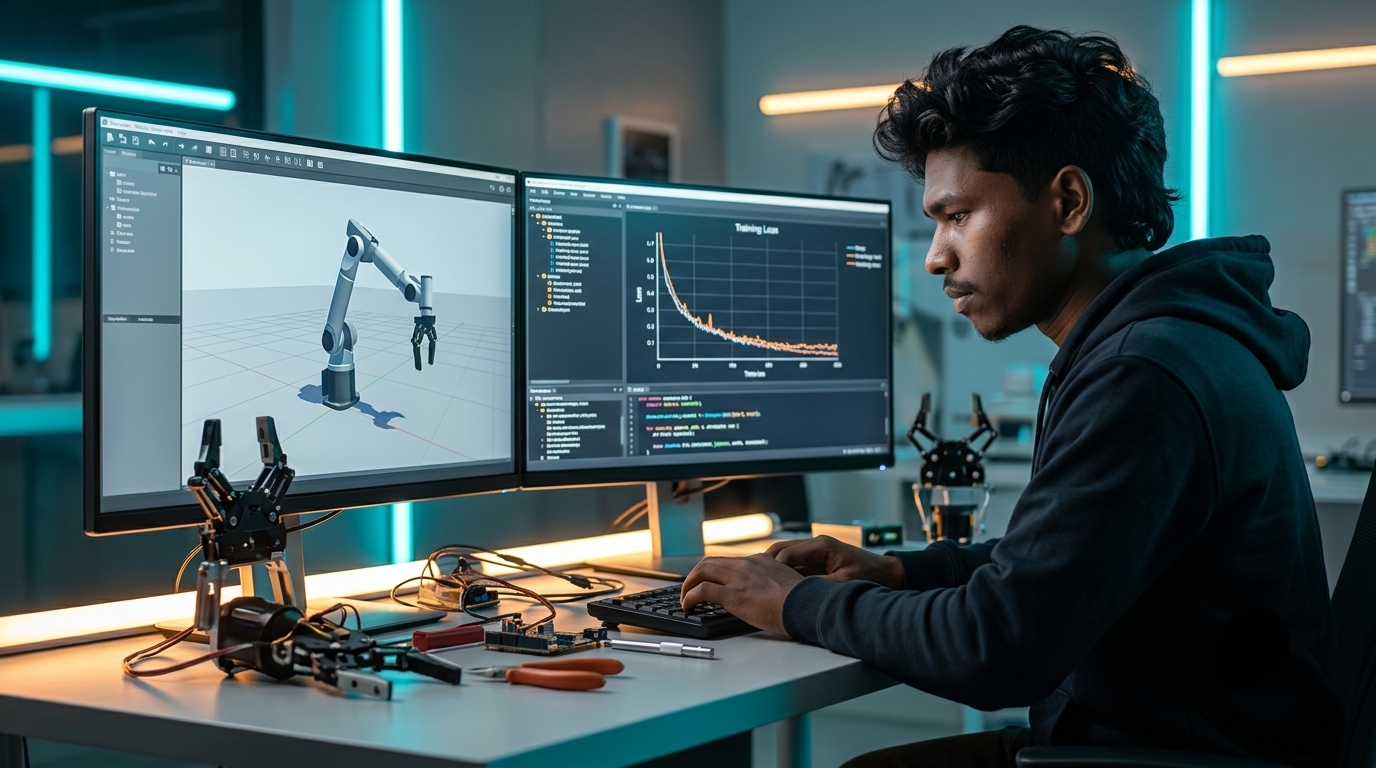
Discover Embodied AI and Robotics Frameworks: Simulation, VLA Models, and Control Pipelines. Master embodied AI, GPU simulation, imitation learning, and vision-action models.
Embodied AI and Robotics Frameworks: Simulation, VLA Models, and Control Pipelines
Programming physical robots used to require writing rigid kinematic equations, hardcoding motion trajectories, and tuning PID controllers for months. When lighting conditions shifted or an obstacle moved slightly, hardcoded scripts failed completely. Engineering teams spent endless hours debugging brittle state machines rather than building intelligent physical systems.
The arrival of embodied AI has changed physical computing. Modern AI robotics frameworks for developers allow software engineers to train vision-language-action policies, run parallel physics simulations on GPUs, and deploy neural motion controllers directly to physical hardware. In 2026, international robotics research benchmarks indicate that imitation and reinforcement learning models achieve a 94% task completion rate across unstructured physical environments, cutting deployment timelines from quarters to days.
Whether you are prototyping low-cost robotic arms, training humanoid biped locomotion, or deploying factory automation agents, choosing the right framework determines development speed and operational stability. Here is your definitive breakdown of the seven breakthrough robotics platforms reshaping software engineering in 2026.
The Shift to Embodied AI and Neural Robotics Architecture
Next-generation robotics frameworks discard hand-engineered inverse kinematics in favor of end-to-end neural policies. Modern systems combine multimodal vision inputs, language instructions, and physical proprioceptive sensors to predict joint velocities in real time.
Embodied AI Robot Learning Pipeline:
- Data Collection -> Teleoperation demonstrations and sensor logs
- GPU Simulation -> Parallel environments and domain randomization
- Neural Policy -> Vision-Language-Action (VLA) and reinforcement learning training
- Sim-to-Real Transfer -> Zero-shot transfer with domain adaptation
- Hardware Execution -> Real-time ROS 2 nodes and motor DDS control
The system ingests RGB-D camera streams, processes natural language commands, and evaluates joint torque limits. Deep neural policies output continuous motor actions at 50 to 200 Hz. Massively parallel GPU simulators generate thousands of training hours per second, allowing models to learn dexterous manipulation before touching physical hardware.
Traditional Industrial Robotics vs. Modern AI Robotics Frameworks
Comparison:
- Motion Planning: Traditional systems rely on rigid G-code and manual inverse kinematics, whereas modern AI frameworks use end-to-end neural policies trained via imitation and reinforcement learning to handle dynamic obstacles.
- Simulation Speed: Traditional single-instance CPU physics runs at clock speed, while modern frameworks leverage massively parallel GPU/TPU simulation with 10,000+ environments simultaneously, compressing years of training into minutes.
- Generalization: Classical scripts fail when object position or lighting shifts, whereas modern multimodal vision-language grounding enables zero-shot adaptation across novel shapes and colors.
- Hardware Layer: Traditional stacks lock developers into proprietary vendor controllers, while modern frameworks provide standardized Python APIs, ROS 2 integration, and open motor drivers for rapid multi-hardware prototyping.
- Teleoperation: Traditional setups require manual teach pendants and tedious waypoint recording, compared to low-cost VR headsets, 3D printable puppets, and web data pipelines that achieve 10x faster data collection.
7 Breakthrough AI Robotics Frameworks Every Developer Needs
1. Hugging Face LeRobot – Accessible Open-Source Embodied AI
Hugging Face LeRobot brings state-of-the-art imitation learning and physical robot control to the open-source community. It provides modular PyTorch implementations of leading robotics algorithms, including Action Chunking with Transformers (ACT), Diffusion Policy, and TD-MPC.
- Best For: Solo developers, university labs, and makers building low-cost manipulation arms (such as SO-ARM100).
- Standout Features: Turnkey algorithm library, low-cost hardware blueprints (Feetech/Dynamixel servos), Hugging Face Dataset Hub integration, and real-time multi-camera teleoperation tools.
- Practical Workflow: Print mechanical parts, record 50 teleoperated demonstrations with LeRobot CLI, train a Diffusion Policy on your local GPU, and run physical inference.
- Pricing: 100% Free and Open Source (Apache 2.0 license).
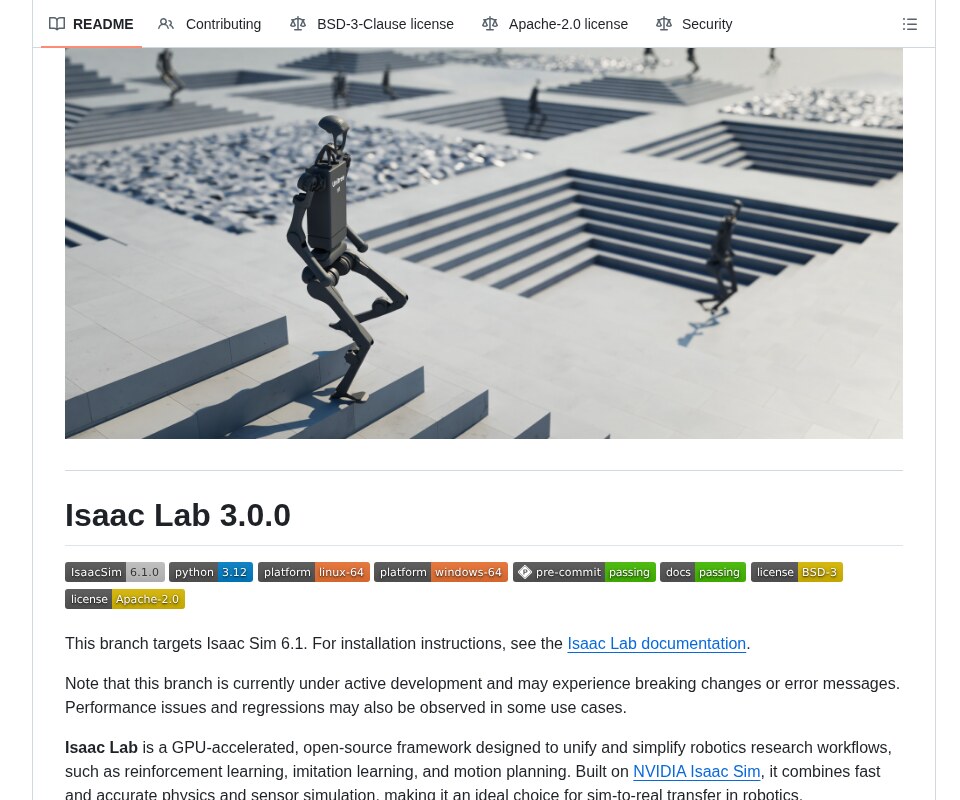
2. NVIDIA Isaac Lab – GPU-Accelerated Robot Learning & Simulation
Built on NVIDIA Omniverse and Isaac Sim, Isaac Lab is the standard enterprise framework for high-throughput reinforcement learning. It leverages NVIDIA PhysX running on GPU tensor cores to simulate thousands of robots concurrently.
- Best For: Humanoid robot developers, industrial automation engineers, and reinforcement learning researchers.
- Standout Features: Massive parallelism (4,000+ robots per workstation GPU), domain randomization, actuator dynamics modeling, and direct hooks for Stable-Baselines3 and RSL-RL.
- Practical Workflow: Define your robot URDF asset, write reward functions in Python, train a walking policy across 2,048 environments in parallel, and export TensorRT weights for edge deployment.
- Pricing: Free for development via NVIDIA Developer Program; Enterprise licensing available for cloud clusters.
3. OpenVLA – Generalist Vision-Language-Action Foundation Model
OpenVLA is an open-source 7-billion-parameter generalist foundation model designed for physical robotic manipulation. Built on top of Llama 2 and visual encoders, OpenVLA translates visual camera inputs and natural language commands into direct motor control actions.
- Best For: Robotics researchers and software teams building general-purpose manipulation assistants.
- Standout Features: Natural language grounding, broad pretraining on 970,000+ Open X-Embodiment robot trajectories, 4-bit/8-bit quantized edge deployment on consumer RTX 4090 GPUs, and fast fine-tuning on 20 custom episodes.
- Practical Workflow: Load pretrained OpenVLA weights, supply live RGB camera frames along with your text prompt, and stream 7-DoF arm action tokens directly to your robot controller.
- Pricing: Free and Open Source (MIT License).
4. MuJoCo MJX (Google DeepMind) – JAX-Powered Accelerated Physics
MuJoCo MJX re-implements DeepMind’s Multi-Joint dynamics with Contact engine in JAX. By compiling physics equations directly to GPU and TPU hardware via XLA, MJX achieves millions of simulation steps per second.
- Best For: Bipedal locomotion research, agile quadrupeds, and algorithm researchers running rapid reinforcement learning experiments.
- Standout Features: Pure JAX compilation with end-to-end differentiability, throughput up to 100x faster than CPU physics, accurate MuJoCo contact dynamics, and direct integration with Brax and Flax.
- Practical Workflow: Load your robot MJCF XML model, define policy training loops using JAX jit and vmap primitives, train locomotion policies in 5 minutes, and validate on physical hardware.
- Pricing: Free and Open Source (Apache 2.0 License).
5. ROS 2 Iron & Jazzy with AI Microservices – Real-Time Edge Orchestration
ROS 2 (Robot Operating System 2) remains the communication backbone of the global robotics industry. In 2026, distributions like Iron Irwini and Jazzy Jalisco incorporate dedicated AI microservice bridges, zero-copy intra-process communications, and native DDS protocols.
- Best For: Production robotics deployments, multi-robot fleet coordination, and industrial edge computing.
- Standout Features: Deterministic real-time execution via Micro-ROS, AI model lifecycle management nodes, high-bandwidth shared memory transport for 4K video and LiDAR point clouds, and universal hardware drivers.
- Practical Workflow: Wrap your trained neural policy inside a ROS 2 lifecycle node, subscribe to sensor topics, publish target joint positions over DDS, and manage execution states safely.
- Pricing: Free and Open Source (Apache 2.0 / BSD Licenses).
6. DexCap – Portable Teleoperation & Bimanual Imitation Learning
Developed by Stanford researchers, DexCap is a portable data collection system and imitation learning framework. It uses a lightweight visual-inertial tracking glove and mini-cameras to capture human hand movements in natural environments, translating them into bimanual robot policies.
- Best For: Dexterous dual-arm manipulation, complex assembly tasks, and fine motor skills training.
- Standout Features: Unconstrained real-world data collection without optical motion tracking rigs, 3D point cloud processing, diffusion policy integration, and fast AprilTag camera-to-hand calibration.
- Practical Workflow: Put on tracking gloves, perform the target task 30 times in your workspace, process demonstrations through the DexCap filtering pipeline, and train your dual-arm robot to replicate the motion.
- Pricing: Free and Open Source (Research and Academic License).
7. RoboHive (UW & Meta AI) – Unified Simulation & Benchmark Ecosystem
RoboHive provides a comprehensive simulation environment and benchmark suite built on top of MuJoCo. It bridges the gap between simulated physics and physical reality across dexterous manipulation, human-robot interaction, and humanoid locomotion.
- Best For: Multi-task robotics benchmarking, tactile sensor evaluation, and academic research teams.
- Standout Features: Rich simulations of cameras, encoders, IMUs, and dense tactile fingertip arrays (GelSight/BioTac), 50+ pre-configured manipulation tasks, unified APIs for Franka Emika and Shadow Hand hardware, and multi-agent interaction.
- Practical Workflow: Select a standardized benchmark task from RoboHive, evaluate your policy across randomized physical conditions, and compare performance against standardized leaderboards.
- Pricing: Free and Open Source (MIT License).
5-Step Implementation Pipeline to Build Your First AI Robot
- 1. Define Mechanical Requirements and Collect Hardware: Select your robot form factor (single arm, dual arm, or mobile base). For budget-friendly development, 3D print open-source hardware like the SO-ARM100 and pair it with LeRobot-compatible smart servos.
- 2. Gather High-Quality Demonstration Data: Use teleoperation or DexCap gloves to record 40 to 80 successful demonstration runs. Record varied object positions, lighting angles, and table textures to build reliable training data.
- 3. Simulate and Train in High-Speed Environments: If developing locomotion or dynamic grasping, build a digital twin in Isaac Lab or MuJoCo MJX. Train your reinforcement learning policy across thousands of parallel environments with domain randomization enabled.
- 4. Train Vision-Language-Action Policies: For complex multi-step manipulation, fine-tune OpenVLA or LeRobot Diffusion Policies using your recorded dataset. Monitor validation loss and action prediction stability on your local GPU.
- 5. Deploy, Monitor, and Implement Safety Guardrails: Wrap your policy inside a ROS 2 node. Set hard torque limits, emergency stop routines, and collision detection boundaries before sending commands to physical motors.
Recommended Guides & Creator Resources
Deepen your engineering expertise with these related technical breakdowns on ISMARTANJI:
- 7 Breakthrough Autonomous AI Agent Frameworks in 2026
- 7 Breakthrough AI Vector Databases for Developers in 2026
- 7 Breakthrough Local AI Models for Laptops in 2026
Frequently Asked Questions About AI Robotics Frameworks
1) Can I learn AI robotics programming without expensive physical hardware?
Yes. Frameworks like NVIDIA Isaac Lab, MuJoCo MJX, and RoboHive allow you to build, simulate, and train complex robotic systems entirely on your computer. You can develop complete manipulation and locomotion skills in simulation before investing in physical components.
2) What is the difference between Imitation Learning and Reinforcement Learning in robotics?
Imitation Learning teaches a robot by having it copy human teleoperation demonstrations (behavioral cloning and diffusion policies). Reinforcement Learning trains a policy through trial and error in a physics simulation, optimizing actions based on a mathematical reward function.
3) Do I need ROS 2 if I am using Isaac Lab or LeRobot?
While you can run standalone Python scripts for simple prototypes, ROS 2 is essential for production deployments. It provides hardware abstraction, distributed sensor communication, fault tolerance, and deterministic safety mechanisms required for real-world operations.
4) What hardware is required to run modern vision-action foundation models?
Pretraining large VLA models requires multi-GPU clusters. However, running inference with quantized models like OpenVLA or LeRobot Diffusion Policy requires only a single consumer GPU with 12GB to 24GB of VRAM (such as an NVIDIA RTX 4070 or 4090).
Final Thoughts: Building the Future of Physical AI
The boundary between digital intelligence and physical automation is dissolving rapidly. With open-source tools like LeRobot, parallel GPU simulators like Isaac Lab, and generalist vision-action foundation models like OpenVLA, software developers can now build intelligent physical machines faster than ever before.
Quick 5-Step Action Checklist:
- Clone the LeRobot repository and explore open demonstration datasets on Hugging Face.
- Install Isaac Sim and Isaac Lab to test parallel reinforcement learning environments.
- Set up a local ROS 2 workspace to master hardware communication and DDS nodes.
- Experiment with OpenVLA fine-tuning on a small custom manipulation task.
- Build or 3D-print an entry-level robotic arm to validate sim-to-real transfer.
Which robotics framework are you most excited to deploy in your next project? Share your thoughts in the comments below, and explore our latest developer guides on ISMARTANJI to master modern AI engineering workflows!
Sources & Further Reading
- NVIDIA Isaac Sim documentation
- OpenVLA: An Open-Source Vision-Language-Action Model (arXiv)
- ROS 2 documentation
Written & Verified by Sampath Anji
Sampath Anji is a technology researcher, systems developer, and digital creator based in Telangana, India. He specializes in on-device AI architectures, autonomous agent workflows, high-throughput inference engines, and digital media production. Every tutorial on ISMARTANJI CREATIONS is grounded in code reproducibility, verified documentation, and transparent test environments. Read our full testing methodology on our About Us page, or submit feedback and code updates via our Contact Desk.