
Short answer: on 13 November 2026 almost nothing changes for you as an ordinary user. Only one part of the DPDP Rules starts that day: the rules for "consent managers", which are companies that can now apply to be registered. The rules that touch your daily life (consent notices, your right to correct or erase data, breach alerts) start 18 months after the Rules were published, which is 13 May 2027. You do not have to sign up for anything, pay anyone, or "update your consent" through a link.
Headlines this week say the data protection law "kicks in". Founders on r/IndiaBusiness say they see conflicting takes on what is due when, and ordinary readers are even more lost. This guide sorts the dates, explains what a consent manager is in plain words, and gives you a short list of things worth doing now.
Which dates matter, and which do not?
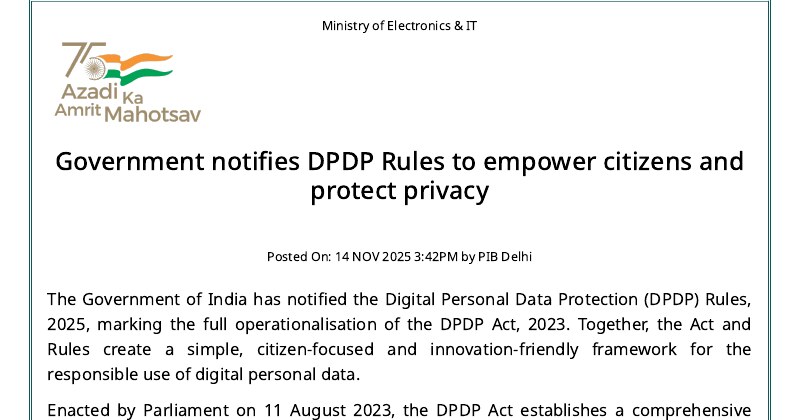
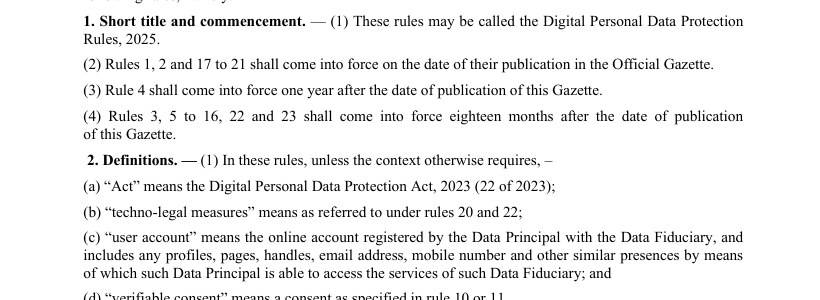
The Rules were published in the Gazette on 13 November 2025. Rule 1 of the Rules itself sets three clocks, and I checked this in the Gazette text. Some rules (1, 2 and 17 to 21) started on the day of publication. Rule 4 starts one year after publication. Rules 3, 5 to 16, 22 and 23 start eighteen months after publication.
| Date | What starts | Does it change your phone or apps? |
|---|---|---|
| 13 Nov 2025 | Rules 1, 2, 17 to 21 (setup of the Data Protection Board and definitions) | No |
| 13 Nov 2026 | Rule 4: how consent managers register and what they must do | No, not on the day |
| 13 May 2027 | Rules 3, 5 to 16, 22, 23: notices, consent steps, your rights, breach duties, children’s data | Yes, this is the big one |
So the date in the news is real, but it is a start date for a new type of company, not a switch that changes your apps overnight. Think of it like a new bank licence opening for applications. The licence round starts first. Customers feel the change later.
What is a consent manager in simple words?
Today every app asks its own permission. Your bank, your food app and your shopping app each keep their own record of what you agreed to. A consent manager is meant to be one place where you can see those agreements and give or take back consent. The PIB release only says these are entities that help people manage permissions and that they must be Indian companies.
The Gazette text adds more detail. Anyone who wants to run one has to apply to the Data Protection Board. The conditions include being a company incorporated in India with net worth of at least two crore rupees, and sound management. The Board can register or reject the application, and it can suspend or cancel a registration later. Rule 4 does not say that you must use one, and it does not say that apps must send you to one. It sets up a registration system. A good way to think of it: a new option may appear, and you can ignore it.
Simple test:
If someone says you must use a certain app or website to "register your consent" this month, ask which part of Rule 4 says so. Rule 4 is about companies applying to the Board, not about individuals registering anything.
Why is everyone confused?
- Two dates, one headline. News stories say "DPDP starts 13 November" and skip the May 2027 part.
- Old news looks new. The Rules were announced a year ago. A story that repeats them this week feels like a fresh change.
- Companies are advertising. Many compliance firms and software sellers launch products around this date, so their posts sound urgent.
- Scammers copy official words. A date plus a government-sounding word is a good bait for an SMS.
What should you actually do before 13 November?
Nothing is compulsory. But the next six months are a good time to clean up, so you are ready when your rights start in May 2027. Here is a routine that takes about twenty minutes.
- Open your app permissions. On most Android phones: Settings, then Apps, then pick an app, then Permissions. On Pixel and many other phones you can also use Settings, then Security and privacy, then Privacy, then Permission manager. On Samsung the path is Settings, then Security and privacy, then Privacy, then Permission usage. Take away contacts, location and microphone from apps that do not need them.
- List the apps that hold your serious data. Banking, UPI, insurance, health, and any app where you gave Aadhaar or PAN. Write the names in your notes. When the rights start, you will know where to send requests.
- Delete accounts you no longer use. An old shopping app from college days still holds your phone number and address. Less data out there means less to leak.
- Check your registered email and mobile number in your important accounts. The Gazette text says companies can identify you by things like your email address or mobile number when you make a request. If those details are old, you may struggle later.
- Turn on two-step verification for Google, WhatsApp and your email.
What will really change for you in May 2027?
From the PIB summary and the Gazette text, these are the changes that matter to a normal user.
- Clear consent notices. Companies must give a notice in plain language that lists what personal data they collect and why. The Gazette says the notice must stand on its own and not be buried in other text.
- Your rights. You can ask a company that holds your data to show it, correct it or erase it. You can also name someone to use these rights for you. Rule 14 says you send the request to the company you gave consent to, using the way that company publishes on its website or app.
- Time limit. PIB says companies must answer such requests within a maximum of 90 days. The Gazette says the grievance system must also reply within a period not more than ninety days.
- Breach alerts. If your data leaks, the company has to tell you in plain language what happened, what it may mean for you and who to contact.
- Children’s data. A parent or guardian must give verifiable consent before a company processes a child’s data, with limited exceptions such as health and education.
- Complaints. The Data Protection Board is designed to work digitally, so complaints can be filed and tracked online.
Notice what is not on this list: an extra form you must fill, a fee, or a deadline for you. The duties fall on the companies.
How to spot a fake DPDP message
Whenever a rule gets in the news, fake messages follow. I have not seen one specific message for this date, but the pattern is old: a real-sounding law, a short deadline and a link. For example, a student gets an SMS saying his bank account will be blocked tonight unless he "updates DPDP consent" on a link. That has no basis in the Rules, which give companies months, not hours.
| Sign | What it usually means | What to do |
|---|---|---|
| Deadline in hours | Pressure tactic | Stop and wait |
| Link from a random number | Phishing | Do not tap it |
| Asks OTP, PIN, card or Aadhaar | Fraud | Never share |
| Asks a fee to "register consent" | Scam, no such fee in the Rules | Do not pay |
| Caller says he is from the Data Protection Board | Likely fake, Board works through its own online system | Hang up |
If you already clicked or paid, call 1930 at once and report on the national cyber crime portal. Your bank also needs a call immediately to block the card or account.
Safer habit:
Open your bank or app by typing its name in the Play Store or using the app you already have. Never use a link from an SMS to reach a login page.
If you run a small shop or small online business
The duties of May 2027 will apply to you if you collect customer details. A kirana store with a delivery WhatsApp group, a tuition centre with student phone numbers, a small online seller with address lists: all hold personal data. Skipping registration as a consent manager is fine, because Rule 4 is only for companies that want to run one. The date to plan for is 13 May 2027.
- Write down where customer data sits: Excel, Google Sheets, WhatsApp, billing app.
- Delete old lists you do not use.
- Keep one person responsible and publish a contact email.
- Ask your billing or CRM software company what they are doing for May 2027.
- Prepare a plain-language notice in the language your customers use, such as Telugu or Hindi, with what you collect and why.
Common mistakes
- Believing nothing exists until 2027. Some Rules are already running, including those that set up the Board.
- Believing everything starts on 13 November. Only Rule 4 does.
- Thinking you must register with a consent manager. The Rules create the option, not a duty for you.
- Clicking "update consent" links in SMS. Real changes will not need that.
- Waiting for a Telugu or Hindi explainer before cleaning permissions. You can do that today.
FAQ
Is the DPDP law starting on 13 November 2026?
Only Rule 4 on consent managers starts then. The Gazette says Rules 3, 5 to 16, 22 and 23 start eighteen months after publication, which is May 2027.
Do I have to register my consent anywhere?
No. Rule 4 is about companies applying to the Data Protection Board. It does not ask individuals to register.
Can I ask Google, my bank or an app to delete my data right now?
The legal rights under the new Rules begin in May 2027. Until then you can still use the delete and privacy options inside each app and the company’s own support channel.
How long will companies have to answer my request?
PIB says a maximum of 90 days. Shorter replies are allowed. The 90 days is the outer limit.
Where do I report a DPDP scam message?
Call 1930 or use the national cyber crime reporting portal. Share the sender number and the link with them and do not click it.
Sources & Documentation
- PIB: Government notifies DPDP Rules to empower citizens and protect privacy (18-month plan, consent managers, 90-day response, Board)
- MeitY: DPDP Rules, 2025 Gazette notification G.S.R. 846(E) (Rule 1 dates, Rule 4 conditions, Rule 14 rights)
- National Cyber Crime Reporting Portal (report scams; helpline 1930)
Written & Verified by Sampath Anji
Sampath Anji is a technology researcher, systems developer, and digital creator based in Telangana, India. He specializes in on-device AI architectures, autonomous agent workflows, high-throughput inference engines, and digital media production. Every tutorial on ISMARTANJI CREATIONS is grounded in code reproducibility, verified documentation, and transparent test environments. Read our full testing methodology on our About Us page, or submit feedback and code updates via our Contact Desk.