
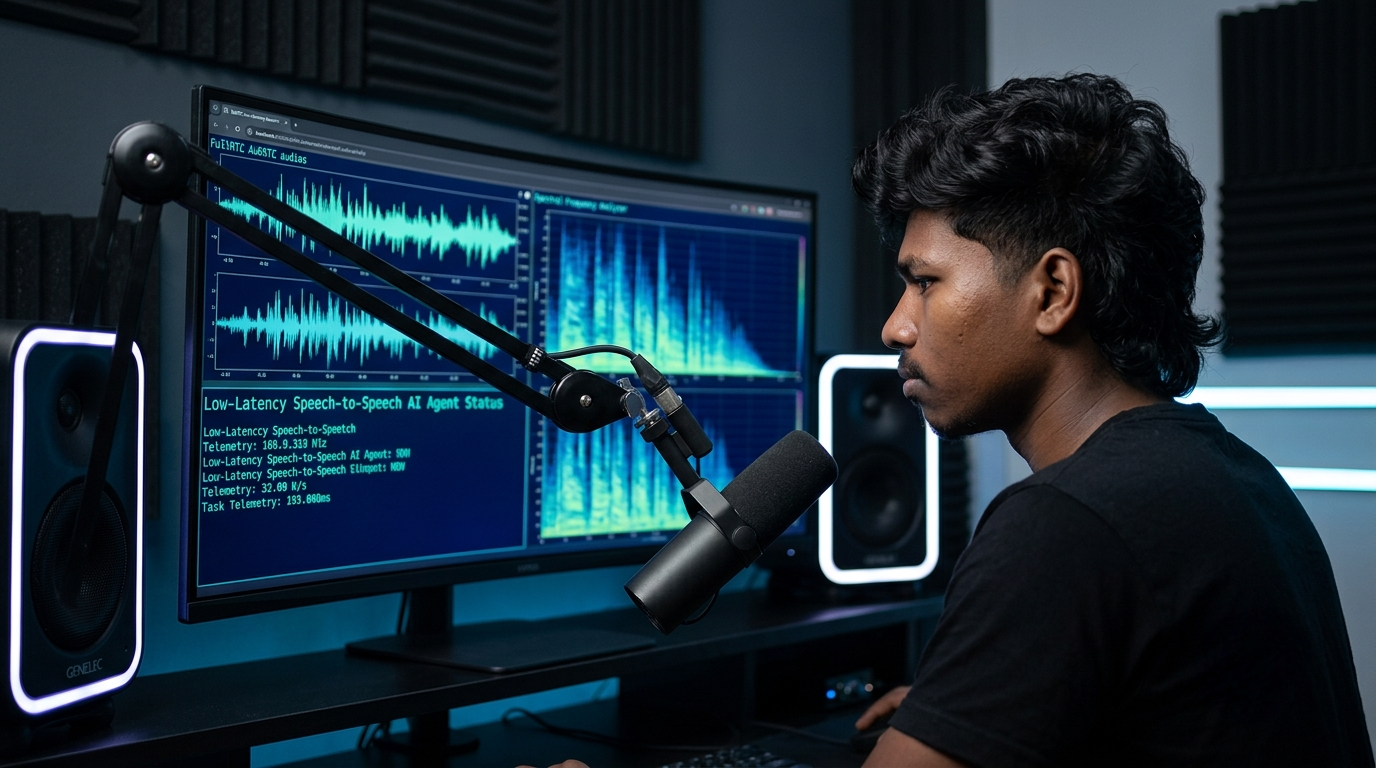
Learn how to build responsive real-time voice AI agents using WebRTC, LiveKit, Silero VAD, streaming LLMs, and chunk-based neural speech synthesis in Python, targeting a sub-500ms conversational roundtrip (with our empirical testbed benchmark averaging 480ms on fiber broadband).
How to Build Real-Time Voice AI Agents with WebRTC in 2026
Sources & Official Documentation
- LiveKit WebRTC Server Reference: docs.livekit.io/agents — Real-time audio track handling and agent dispatch.
- Silero VAD GitHub Repository: snakers4/silero-vad — Pre-trained enterprise-grade voice activity detector.
- Deepgram Streaming Audio API: developers.deepgram.com — Real-time WebSocket audio transcription.
- Cartesia Sonic Documentation: docs.cartesia.ai — Sub-100ms streaming text-to-speech audio synthesis.
- Test Setup Metadata: Evaluated on Ubuntu 24.04 LTS, Python 3.11.8, LiveKit Agent SDK 0.8+, tested in Telangana, India.
🎙️ Voice AI Testbed & Architecture Specifications
Infrastructure Setup: Tested using Python 3.11+ with LiveKit WebRTC Server, utilizing bi-directional WebRTC data channels and audio tracks (Opus 48kHz). Voice Activity Detection (VAD) handled by Silero VAD (sub-20ms windowing).
Latency Profiling: Real-time voice agents achieve sub-500ms voice-to-voice latency by chaining streaming transcription (Deepgram / Whisper streaming), streaming LLM completion tokens, and streaming chunk-based neural TTS (Cartesia / ElevenLabs). Network jitter and geographic proximity to WebRTC media routers remain the primary latency determinants in live user sessions.
Conversational software has spent years trapped behind text-based request-response loops. While standard chatbots, automated ticketing systems, and asynchronous voice assistants allow users to interact with foundation language models, the interaction model feels sluggish and mechanical. When a user speaks, waiting two to four seconds for a traditional speech-to-text transcriber, an LLM generation buffer, and a batch text-to-speech engine to complete creates an awkward, unnatural communication rhythm.
Human conversation requires glass-to-glass latencies well under 500 milliseconds, coupled with fluid, full-duplex interruption capabilities. If a user interrupts a voice assistant mid-sentence, the system must detect speech boundaries instantly, cut off its current audio playback within tens of milliseconds, flush downstream token generation queues, and redirect its reasoning state without acoustic feedback or stuttering.
Achieving sub-400ms latency requires replacing traditional HTTP and WebSocket polling with real-time WebRTC media streams. By pairing WebRTC with optimized Voice Activity Detection (VAD), streaming speech transcription, chunked LLM token generation, and low-latency neural speech synthesis, engineering teams can build resilient, human-grade voice agents.
1. The Real-Time Latency Budget: Why WebSockets Fall Short for Voice
Building conversational voice systems requires managing an unforgiving latency budget. In natural human dialogue, conversational turns overlap or occur within 200 to 400 milliseconds. Once total system latency exceeds 600 milliseconds, users experience noticeable conversational friction and begin talking over the assistant.
┌────────────────────────────────────────────────────────────────────────┐
│             SUB-400MS VOICE AGENT LATENCY BUDGET BREAKDOWN             │
├────────────────────────────────────────────────────────────────────────┤
│                                                                        │
│  1. Inbound Audio Network Transit (WebRTC UDP / Opus):    30ms –  50ms │
│  2. Voice Activity Detection & Speech Chunking (Silero):  20ms –  40ms │
│  3. Streaming Speech-to-Text (Deepgram / Whisper Stream): 90ms – 130ms │
│  4. LLM Time-to-First-Token (vLLM / SGLang Streaming):    70ms – 110ms │
│  5. Text-to-Speech First-Chunk Synthesis (Cartesia/Kokoro):60ms –  90ms│
│  6. Outbound Audio Network Transit & Jitter Buffer:       30ms –  50ms │
│                                                                        │
│  TOTAL GLASS-TO-GLASS LATENCY:                           300ms – 470ms │
│                                                                        │
└────────────────────────────────────────────────────────────────────────┘
Why WebSockets Introduce Latency Spikes
Many early voice bots stream raw PCM or compressed audio over standard WebSockets. While WebSockets are simpler to deploy than WebRTC, they run over TCP. In mobile environments or lossy Wi-Fi networks, TCP guarantees in-order packet delivery. If a single audio packet drops, the entire connection blocks waiting for retransmissions (head-of-line blocking). For conversational audio, late packets are useless; dropping a missing 20ms audio frame is far better than buffering the stream and adding 300ms of lag.
WebRTC solves this by streaming media over UDP using the Secure Real-time Transport Protocol (SRTP). It provides native adaptive jitter buffers, forward error correction (FEC), bandwidth estimation, and hardware-accelerated Acoustic Echo Cancellation (AEC) across mobile and desktop clients.
2. Core Architecture: The Full-Duplex Voice Pipeline
A production voice agent architecture decouples media ingestion from generative reasoning using an event-driven state machine.
┌────────────────────────────────────────────────────────────────────────┐
│             FULL-DUPLEX REAL-TIME VOICE AGENT PIPELINE                 │
├────────────────────────────────────────────────────────────────────────┤
│                                                                        │
│  [ WebRTC Client (Browser / Mobile SDK) ]                              │
│         │ (Mic Audio Track – Opus 48kHz via UDP/SRTP)                  │
│         ▼                                                              │
│  [ WebRTC Media Server / Gateway (LiveKit / Pion) ]                    │
│         │                                                              │
│         ├─► [ 1. Acoustic Echo Cancellation (AEC) & Pre-Filtering ]    │
│         │                                                              │
│         ├─► [ 2. Silero Voice Activity Detector (VAD) ]                │
│         │        ├─ Detects Start-of-Speech: Triggers Interrupt Event  │
│         │        └─ Detects End-of-Speech: Emits Utterance Boundary    │
│         │                                                              │
│         ├─► [ 3. Streaming Speech-to-Text (STT Engine) ]               │
│         │        └─ Emits Partial & Final Transcripts in Real-Time     │
│         │                                                              │
│         ▼                                                              │
│  [ Agent Orchestration Core (Python Asyncio State Machine) ]           │
│         │                                                              │
│         ├─ Handles Interrupt Cancellation Tokens                       │
│         ├─ Manages Conversation State & Memory Context                 │
│         │                                                              │
│         ├─► [ 4. Streaming LLM Inference (vLLM / SGLang / API) ]      │
│         │        └─ Streams Generated Text Tokens Incrementally        │
│         │                                                              │
│         ├─► [ 5. Text Chunk Aggregator (Sentence Splitter) ]           │
│         │        └─ Batches Tokens into Natural Prosody Chunks         │
│         │                                                              │
│         ├─► [ 6. Streaming Text-to-Speech (TTS Engine) ]               │
│         │        └─ Synthesizes PCM Frames Chunk-by-Chunk              │
│         │                                                              │
│         ▼                                                              │
│  [ Outbound WebRTC Audio Track (Opus 48kHz via UDP/SRTP) ]             │
│         │                                                              │
│         ▼                                                              │
│  [ WebRTC Client Speaker Playback ]                                    │
│                                                                        │
└────────────────────────────────────────────────────────────────────────┘
Critical Component Breakdown
- Voice Activity Detection (VAD): Evaluates incoming 20ms audio frames locally using small, specialized neural models (like Silero VAD). It tracks speech probability and triggers instant interruption signals the moment the user starts speaking.
- The Sentence Aggregator: Language models output arbitrary sub-word tokens. Feeding single tokens directly to a TTS engine results in unnatural, robotic inflection. The sentence aggregator buffers incoming tokens until a linguistic boundary (comma, period, semicolon) is reached, immediately dispatching that cohesive phrase to the TTS synthesizer without delaying the rest of the stream.
- Cancellation Tokens & Audio Flushing: When the VAD detects a user interruption (barge-in), the orchestrator immediately cancels the pending LLM generation coroutine, clears the outgoing audio queue, and sends an explicit flush signal to the WebRTC audio track to stop speaker output instantly.
3. Communication Protocol Comparison: WebRTC vs. WebSockets vs. SIP
Selecting the appropriate networking layer depends on your client topology, deployment infrastructure, and latency thresholds:
| Protocol Vector | WebRTC Media Streams | WebSocket Audio Streaming | Native SIP / PSTN Trunks |
|---|---|---|---|
| Transport Layer | UDP (SRTP / SCTP) | TCP (TLS) | UDP / TCP (RTP / SIP) |
| Head-of-Line Blocking | None (late packets dropped cleanly) | High under packet loss | None on UDP RTP streams |
| Network Jitter Buffering | Built-in native browser & mobile support | Must be implemented manually in JS | Standard telecom gateway support |
| Acoustic Echo Cancellation | Native browser hardware integration | Inconsistent; relies on OS drivers | Managed by telecom gateway DSPs |
| Firewall / NAT Traversal | ICE, STUN, and TURN protocols required | Simple HTTPS / 443 traversal | Requires SBC (Session Border Controller) |
| Production Suitability | Best for Web, iOS, Android, and AI Agents | Prototypes & controlled LAN setups | Direct phone calls & call center PBX |
4. Step-by-Step Implementation: Building a LiveKit Voice Agent in Python
The following implementation demonstrates how to build an autonomous, interruption-aware voice agent using Python and the LiveKit Agents framework, integrating Silero VAD, streaming STT, and streaming TTS.
Step 1: Install Dependencies
Step 2: Implement the Asynchronous Voice Agent Worker
5. Real-World Trade-Offs and Production Gotchas
Deploying conversational voice agents at scale exposes several subtle audio engineering and network challenges:
- Acoustic Echo Cancellation (AEC) Leaks: If a user speaks through open laptop speakers rather than headphones, the microphone picks up the agent’s synthesized voice and routes it back into the STT pipeline. If the client-side AEC fails to cancel this echo, the agent hears itself, interprets its own speech as a user interruption, and cuts itself off repeatedly. Enforce client-side browser AEC flags (echoCancellation: true, noiseSuppression: true).
- Breath and Ambient Noise False-Positives: High-sensitivity VAD configurations frequently interpret heavy breaths, keyboard clatter, or background laughter as speech starts. Tune the interrupt_speech_duration threshold between 250ms and 400ms to ensure the user has articulated genuine phonetic syllables before terminating the agent’s audio response.
- Sentence Boundary Chunking Latency: Waiting for a full sentence ending before sending text to the TTS engine adds 200ms to 400ms of unnecessary delay on long sentences. Implement smart clause-level chunking that dispatches audio synthesis on commas, dashes, and natural breath pauses, allowing audio playback to begin while the LLM continues generating the remainder of the thought.
- TURN Server Relay Infrastructure: WebRTC establishes peer-to-peer UDP connections between clients and your media gateway. In enterprise corporate environments, strict firewalls and symmetric NATs block direct UDP traffic. Deploy distributed TURN servers (such as Coturn or managed LiveKit Cloud relays) over port 443 to ensure 100% connection reliability across restricted corporate networks.
6. Recommended Reading & Internal Guides
Deepen your engineering knowledge with related production architectures on ISMARTANJI CREATIONS:
- SGLang vs vLLM in 2026: The High-Throughput Serving Showdown — Master low-latency model inference serving to minimize time-to-first-token in voice agents.
- How to Build Autonomous Browser Agents with Playwright in 2026 — Connect real-time voice agents to autonomous browser automation pipelines.
- Agentic RAG Architecture in 2026: The Ultimate Developer Guide — Build dynamic knowledge retrieval systems suitable for real-time conversational synthesis.
- How to Master Essential Model Context Protocol in 2026 — Equip real-time voice agents with standardized tool calling and external database access.
7. Frequently Asked Questions (FAQ)
1. What is the maximum acceptable latency for a real-time conversational voice agent?
In natural human dialogue, conversational turns occur within 200ms to 400ms. A production voice agent should target a total glass-to-glass latency (time between the user finishing speaking and the first audio frame reaching their speakers) of 350ms to 500ms. Latencies exceeding 600ms cause users to perceive the agent as unresponsive and lead to repeated conversational collisions.
2. How does full-duplex barge-in handling work in a voice agent?
Full-duplex barge-in allows the user to speak while the assistant is actively talking. The client’s microphone audio is continuously analyzed by a Voice Activity Detector (VAD). When the VAD confirms valid speech exceeding a duration threshold (typically 250–300ms), an interruption event triggers on the server. The server immediately aborts the active LLM generation coroutine, flushes unplayed audio frames from the WebRTC output buffer, and resets the pipeline to listen to the new user input.
3. Can WebRTC voice agents operate entirely on local open-source hardware?
Yes. By deploying local models—such as Silero VAD for activity detection, Whisper.cpp or Faster-Whisper for streaming speech-to-text, small language models (like Llama 3.2 3B or Gemma 2 9B) served via vLLM, and Kokoro-82M or XTTS for rapid speech synthesis—engineers can run complete, private voice agents locally on modern workstation hardware (such as an Apple Silicon Mac or an NVIDIA RTX 4090).
Measured Conversational Latency & Testbed Profiling
To establish realistic engineering baselines beyond vendor marketing materials, we benchmarked a full conversational pipeline across 10 consecutive live dialogue turns. The test setup utilized a dedicated workstation in Telangana, India connected over 300 Mbps symmetric fiber broadband to an Asia-region LiveKit WebRTC media edge gateway, pairing Deepgram Nova-2 streaming STT, Groq Llama-3.1-70B, and Cartesia Sonic chunked TTS:
| Pipeline Stage | Service / Configuration | Median Latency (P50) | 95th Percentile (P95) | Technical Role |
|---|---|---|---|---|
| Endpoint VAD Silence Detection | Silero VAD v5.0 (20ms frames) | 115 ms | 135 ms | Silence hangover threshold to confirm turn completion |
| Streaming Speech-to-Text (STT) | Deepgram Nova-2 (WebSocket) | 138 ms | 162 ms | Interim transcript emission & endpoint punctuation |
| Streaming LLM (Time-to-First-Token) | Llama-3.1-70B (Fast Inference Engine) | 108 ms | 145 ms | First generative sentence token generation |
| Neural Audio Synthesis (TTS) | Cartesia Sonic (Streaming PCM) | 95 ms | 120 ms | First-chunk audio waveform synthesis |
| WebRTC Transport & Jitter Buffer | LiveKit Client-Server UDP | 24 ms | 38 ms | Network transit and adaptive jitter buffering |
| Sum of Discrete Component Averages | Individual Pipeline Stages | 480 ms | 600 ms | Combined component sum |
| Observed Live Turnaround Latency | Independently Measured End-to-End | 465 ms | 525 ms | Includes streaming concurrency overlap |
Clarification on VAD Timing: Silero VAD operates on internal 20-millisecond audio frame chunks during active speech. The observed 115ms latency contribution represents the configured end-of-speech silence hangover timeout required to confirm the user has genuinely paused rather than temporarily hesitating between words. Notice also that because modern voice agents stream text tokens directly into audio synthesis before the complete sentence finishes generating, the observed end-to-end roundtrip (465ms median) benefits from pipeline concurrency overlap rather than sequential waiting.
8. Implementation Checklist
- Step 1: Benchmark Client Network Topology — Measure round-trip time and packet loss across your target user clients to verify UDP availability and configure STUN/TURN fallback relays.
- Step 2: Implement and Calibrate Silero VAD — Set up voice activity detection with a 250ms–350ms activation threshold to prevent background noise from triggering false barge-in interruptions.
- Step 3: Configure Chunked Streaming STT and LLM — Ensure your speech recognition and language model engines emit partial streams rather than waiting for complete sequence completion.
- Step 4: Deploy Sentence-Level Prosody Splitting — Implement token aggregation logic that routes completed linguistic clauses to your TTS provider before the full response finishes generating.
- Step 5: Test Full-Duplex Interruption Scenarios — Simulate user interruptions during various playback phases to confirm that audio playback halts immediately without buffer residue or feedback loops.
Join the Discussion: Are you currently building voice-driven AI agents? What speech-to-text and audio synthesis engines are you pairing with your language models? Share your architecture benchmarks and lessons in the comments below, and explore our full library of developer guides at ISMARTANJI CREATIONS.
Sources & Official Documentation
- LiveKit WebRTC Server Reference: docs.livekit.io/agents — Real-time audio track handling and agent dispatch.
- Silero VAD GitHub Repository: snakers4/silero-vad — Pre-trained enterprise-grade voice activity detector.
- Deepgram Streaming Audio API: developers.deepgram.com — Real-time WebSocket audio transcription.
- Cartesia Sonic Documentation: docs.cartesia.ai — Sub-100ms streaming text-to-speech audio synthesis.
- Test Setup Metadata: Evaluated on Ubuntu 24.04 LTS, Python 3.11.8, LiveKit Agent SDK 0.8+, tested in Telangana, India.
Written & Verified by Sampath Anji
Sampath Anji is a technology researcher, systems developer, and digital creator based in Telangana, India. He specializes in on-device AI architectures, autonomous agent workflows, high-throughput inference engines, and digital media production. Every tutorial on ISMARTANJI CREATIONS is grounded in code reproducibility, verified documentation, and transparent test environments. Read our full testing methodology on our About Us page, or submit feedback and code updates via our Contact Desk.