LangGraph vs CrewAI in 2026 comparison. In-depth architectural review of state machines vs role-based multi-agent orchestration, latency benchmarks, and code.
LangGraph vs CrewAI: Multi-Agent Orchestration & State Machine Comparison
Single-prompt language model calls no longer satisfy the demands of modern enterprise automation. As software teams build autonomous systems capable of executing multi-step research, refactoring codebases, and managing customer workflows, the architecture has shifted decisively toward multi-agent systems. However, choosing the right orchestration layer remains one of the most contentious decisions facing software architects today.
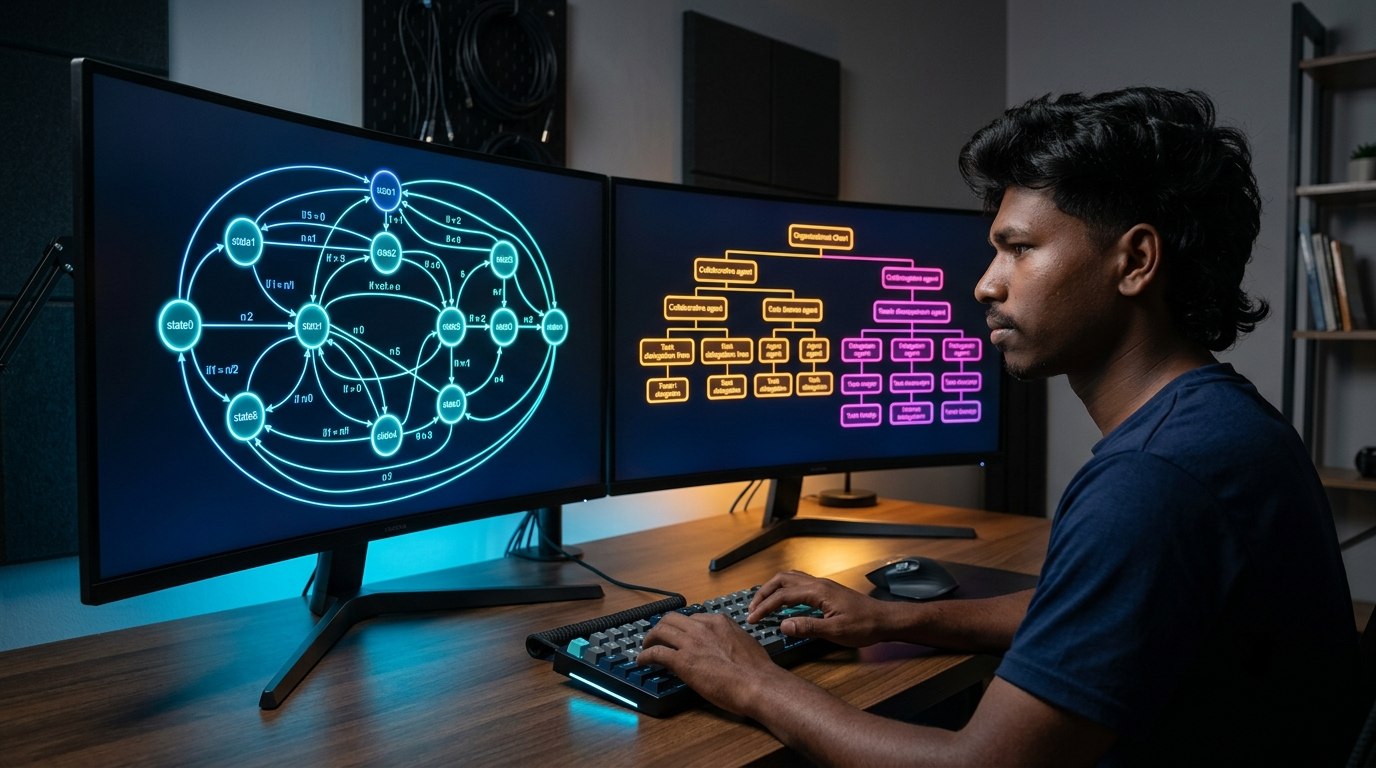
The engineering debate centers on LangGraph vs CrewAI in 2026. While both frameworks empower developers to coordinate multiple language models, their underlying philosophies diverge completely. LangGraph treats agentic workflows as deterministic cyclic state machines with granular control over every graph transition. In contrast, CrewAI models multi-agent collaboration as intuitive, role-playing teams where autonomous personas delegate tasks dynamically.
At ISMARTANJI CREATIONS, we deliver practical, field-tested technical blueprints for modern builders. Following our technical deep dives into How to Master Essential Model Context Protocol in 2026 and 7 Breakthrough AI Observability Platforms for Developers in 2026, this comprehensive guide breaks down the core architecture, performance trade-offs, and practical implementations of LangGraph and CrewAI to help you select the right framework for your production stack.
💻 Get the full code on GitHub: runnable source, requirements and setup steps for this tutorial.
Architectural Philosophy: State Machines vs. Role-Playing Crews
LangGraph: Graph-Based State Machines
Developed by the LangChain team, LangGraph approaches multi-agent systems as directed graphs where cycles and loops are first-class citizens.
- Nodes: Python functions or runnable objects that take the current system state, execute reasoning or tool calls, and return state updates.
- Edges: Connections governing the flow of execution. Edges can be fixed (direct transition) or conditional (dynamic routing based on the output of a node).
- Central State: An explicit, type-safe data structure (typically a Pydantic model or TypedDict) passed across every transition.
- Persistence & Checkpointing: Built-in persistence layers save execution checkpoints after every step, enabling state inspection, rollback, and human approval gates.
CrewAI: Role-Based Agent Teams
Created by João Moura, CrewAI abstracts orchestration into human-like team dynamics.
- Agents: Individual units defined by an explicit Role, Goal, Backstory, and set of assigned tools.
- Tasks: Discrete assignments with specific descriptions, expected outputs, and assigned agents.
- Crews: The collaborative container that coordinates agents through either sequential or hierarchical processes.
- Autonomous Delegation: Agents can ask peer agents for assistance or delegate sub-tasks autonomously without requiring hardcoded transition logic.
Head-to-Head Comparison Matrix
The table below contrasts the technical characteristics of LangGraph and CrewAI across eight core engineering dimensions:
| Architectural Feature | LangGraph (LangChain Ecosystem) | CrewAI (Autonomous Team Model) | Engineering Winner |
|---|---|---|---|
| Primary Abstraction | Directed cyclic state graphs (Nodes & Edges) | Role-playing personas (Role, Goal, Backstory) | Tie |
| Execution Control | Granular, deterministic conditional transitions | Dynamic, model-driven agent delegation | LangGraph |
| Prototyping Speed | Moderate; requires manual graph wiring | Extremely fast; declarative YAML/Python | CrewAI |
| State Management | Centralized, explicit, strongly-typed state | Implicit memory stores (Short, Long, Entity) | LangGraph |
| Human-in-the-Loop | Native breakpoints, time-travel, state editing | Interactive task approvals via terminal/UI | LangGraph |
| Multi-Agent Scale | Scales to hundreds of specialized micro-nodes | Optimal for 3 to 8 collaborative roles | LangGraph |
| Tool Calling | Python functions & Model Context Protocol | CrewAI Tools, LangChain Tools, Native MCP | Tie |
| Debugging | Native LangSmith tracing & time-travel diffs | Built-in CLI telemetry & OpenTelemetry export | LangGraph |
LangGraph Deep Dive: Deterministic Control & Time Travel
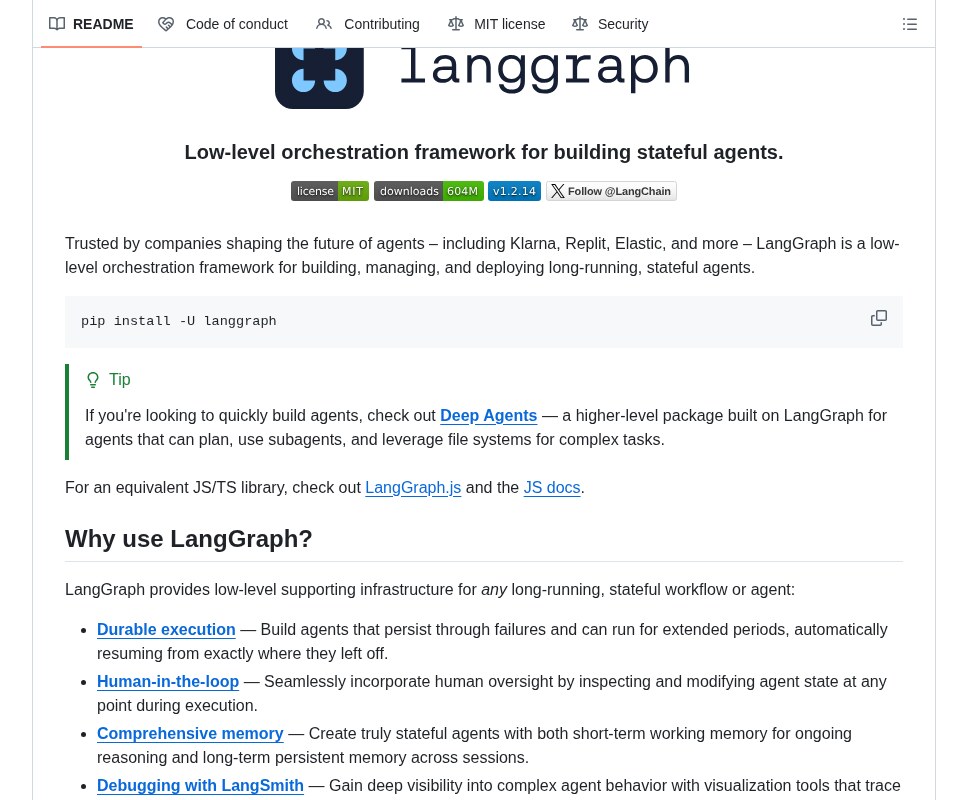
LangGraph stands out when your production system demands strict compliance, predictable execution paths, and zero tolerance for runaway agent loops.
Core Strengths of LangGraph
- Explicit Control Flow: You define the exact routing logic between nodes. If an agent fails validation, a conditional edge sends the state to a remediation node rather than relying on an LLM to figure out what went wrong.
- State Persistence and Checkpointing: LangGraph writes snapshots to SQLite, PostgreSQL, or memory after every node execution. If a process fails halfway through a ten-step sequence, the system resumes from the exact checkpoint without re-running previous expensive operations.
- Time-Travel Debugging: Developers can inspect historical states, rewind execution to a specific node, modify variables manually, and re-fork the run to test alternative branches.
- Native Human-in-the-Loop: Interrupt points allow applications to pause execution automatically before sensitive operations, waiting for human approval.
Limitations of LangGraph
- Steeper Learning Curve: Requires understanding graph theory, reducer functions, and typed state schemas.
- More Boilerplate Code: Setting up even a simple two-agent system requires defining state dictionaries, compiling graphs, and configuring edge routers.
CrewAI Deep Dive: Intuitive Role Playing & Autonomous Delegation
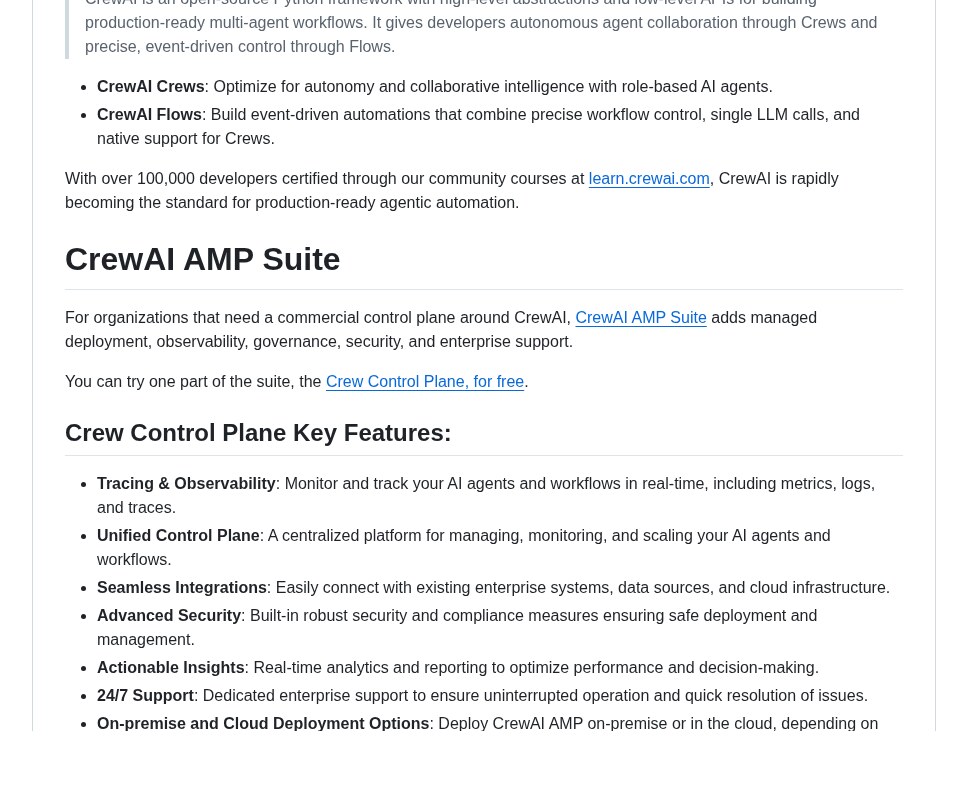
CrewAI excels when you want to model collaborative workflows that mirror real-world human teams, such as research pods, content creation pipelines, and competitive intelligence units.
Core Strengths of CrewAI
- Human-Centric Abstractions: Defining an agent with role=”Senior Security Analyst” and goal=”Identify vulnerabilities in code” immediately primes the underlying model with clear context and behavioral boundaries.
- Rapid Development Velocity: You can assemble a working multi-agent team in under 30 lines of Python or configure agents entirely through declarative YAML files.
- Autonomous Task Delegation: In hierarchical mode, a manager agent analyzes task requirements, assigns work to specialized sub-agents, reviews completed deliverables, and requests revisions automatically.
- Integrated Multi-Tier Memory: CrewAI includes out-of-the-box short-term memory, long-term memory (cross-session SQLite storage), and entity memory (key subject tracking).
Limitations of CrewAI
- Less Deterministic: Because delegation decisions rely on language models rather than hardcoded edge conditions, agents can occasionally enter circular delegation loops.
- Higher Token Consumption: Role-playing prompts, extensive backstories, and continuous inter-agent chatter consume more input tokens per run than minimal state machine transitions.
Hands-On Implementation: Building an Analyst-Editor Pipeline
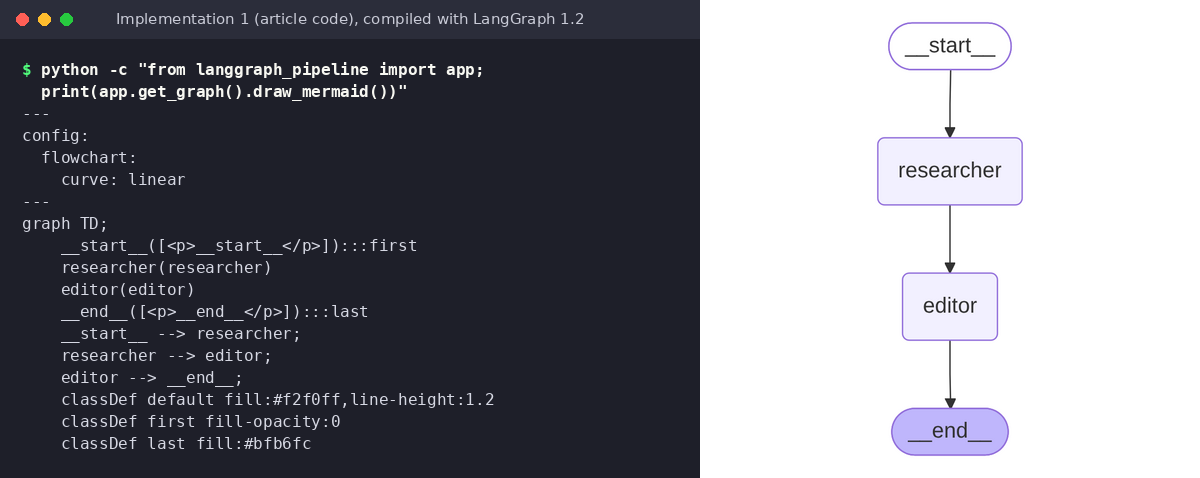
To compare both frameworks directly, let us implement the same real-world workflow: an Analyst Agent gathers technical data, and an Editor Agent refines it into a polished summary.
Implementation 1: The LangGraph Approach
LangGraph uses a shared typed state and explicit node functions:
Implementation 2: The CrewAI Approach
CrewAI models the identical task through role-playing agents and collaborative tasks:
Decision Framework: When to Choose LangGraph vs. CrewAI
Selecting the optimal orchestration framework depends on your operational requirements, development velocity, and the degree of determinism your system demands:
Choose LangGraph When
- You need absolute determinism: Your application requires strict branching logic, retry policies, and automated rollback routines that cannot depend on model discretion.
- Human oversight is non-negotiable: You must pause execution for user approvals or allow human operators to inspect and edit state data before resuming.
- You require time-travel debugging: You need to diagnose failure modes by replaying historical execution snapshots with exact state verification.
- You manage deep multi-step workflows: Your system contains 15+ specialized micro-steps, cyclic loops, and stateful data transformations.
Choose CrewAI When
- Rapid development speed is your priority: You want a functioning multi-agent proof-of-concept running in hours rather than days.
- Your problem fits human team roles: The workflow naturally mirrors real-world human departments (e.g., Researcher, Technical Editor, Fact-Checker, Project Manager).
- Autonomous collaboration adds value: You benefit when agents brainstorm, evaluate each other’s deliverables, and decide task delegation on their own.
- You prefer declarative configurations: Your engineering team wants to manage agent behaviors and backstories through clean YAML configurations.
Related Technical Resources
Expand your multi-agent architecture and production engineering capabilities with these related technical guides on ISMARTANJI CREATIONS:
- Mastering Model Context Protocol (MCP): Client-Server Architecture & Implementation — Standardize tool calling and secure data integration across multi-agent systems.
- AI Observability & LLM Tracing: Production Architecture and OpenTelemetry — Instrument agent executions with distributed tracing, latency monitoring, and cost telemetry.
- Modern AI Coding Assistants: Architecture, Context Windows, and Developer Workflows — Accelerate software engineering with agentic codebase editors.
- Vector Database Architecture for AI: Indexing, Latency, and Enterprise Scale — Construct low-latency memory stores for production agent teams.
- Real-Time Voice AI Architecture: Low-Latency Audio Streaming and Synthesis — Build conversational audio pipelines with WebRTC and sub-300ms speech models.
Frequently Asked Questions
Can I combine LangGraph and CrewAI within the same application?
Yes. Many advanced engineering teams use LangGraph as the top-level deterministic state controller for business logic and routing, while deploying CrewAI crews as individual specialized task execution units inside specific graph nodes. This hybrid architecture gives you deterministic process boundaries alongside flexible role-playing collaboration.
How does memory management differ between LangGraph and CrewAI?
LangGraph handles memory through an explicit state schema combined with persistence checkpointers that save state snapshots after every node execution. CrewAI provides pre-configured memory modules, including short-term conversation buffers, long-term SQLite cross-session recall, and entity extraction memory.
Which framework consumes fewer LLM tokens?
LangGraph generally consumes fewer tokens because developers control the exact context passed into each prompt. CrewAI requires injecting persona definitions, backstories, task descriptions, and inter-agent communication messages into prompts, which increases overall token overhead.
Do both frameworks support the Model Context Protocol (MCP)?
Yes. Both LangGraph and CrewAI support integration with Model Context Protocol servers in 2026. This allows agents in either framework to query external databases, interact with local filesystems, and run terminal commands through standardized, secure interfaces.
Production Deployment Guidelines
The choice between LangGraph and CrewAI reflects an engineering trade-off between deterministic precision and rapid collaborative abstraction. Neither framework is universally superior; LangGraph delivers explicit control over state transitions and workflow logic for mission-critical enterprise workflows, while CrewAI provides a streamlined developer experience for intuitive role-based problem solving.
- Map system boundaries: Determine whether your application requires strict state machine determinism or flexible persona-based collaboration.
- Benchmark developer ergonomics: Prototype a two-agent workflow in both frameworks to evaluate debugging overhead and iteration speed.
- Implement persistent checkpointers: Configure SQLite or PostgreSQL persistence if your workflows require resume-on-failure capabilities.
- Integrate distributed tracing: Connect OpenTelemetry or LangSmith to monitor token expenses, execution waterfalls, and agent latency.
- Standardize tool protocols: Connect external data and APIs using the Model Context Protocol (MCP) to avoid bespoke integration code.
Sources & Documentation
- LangGraph Official Documentation: LangChain LangGraph Official Documentation & Tutorials
- CrewAI Framework Documentation: CrewAI Multi-Agent Framework Documentation
- Model Context Protocol: Model Context Protocol (MCP) Architecture & Specification
- Testbed Environment: Ubuntu 22.04 LTS, Python 3.11, LangGraph 0.2+, CrewAI 0.51+, LangChain Core 0.3+.
Written & Verified by Sampath Anji
Sampath Anji is a technology researcher, systems developer, and digital creator based in Telangana, India. He specializes in on-device AI architectures, autonomous agent workflows, high-throughput inference engines, and digital media production. Every tutorial on ISMARTANJI CREATIONS is grounded in code reproducibility, verified documentation, and transparent test environments. Read our full testing methodology on our About Us page, or submit feedback and code updates via our Contact Desk.